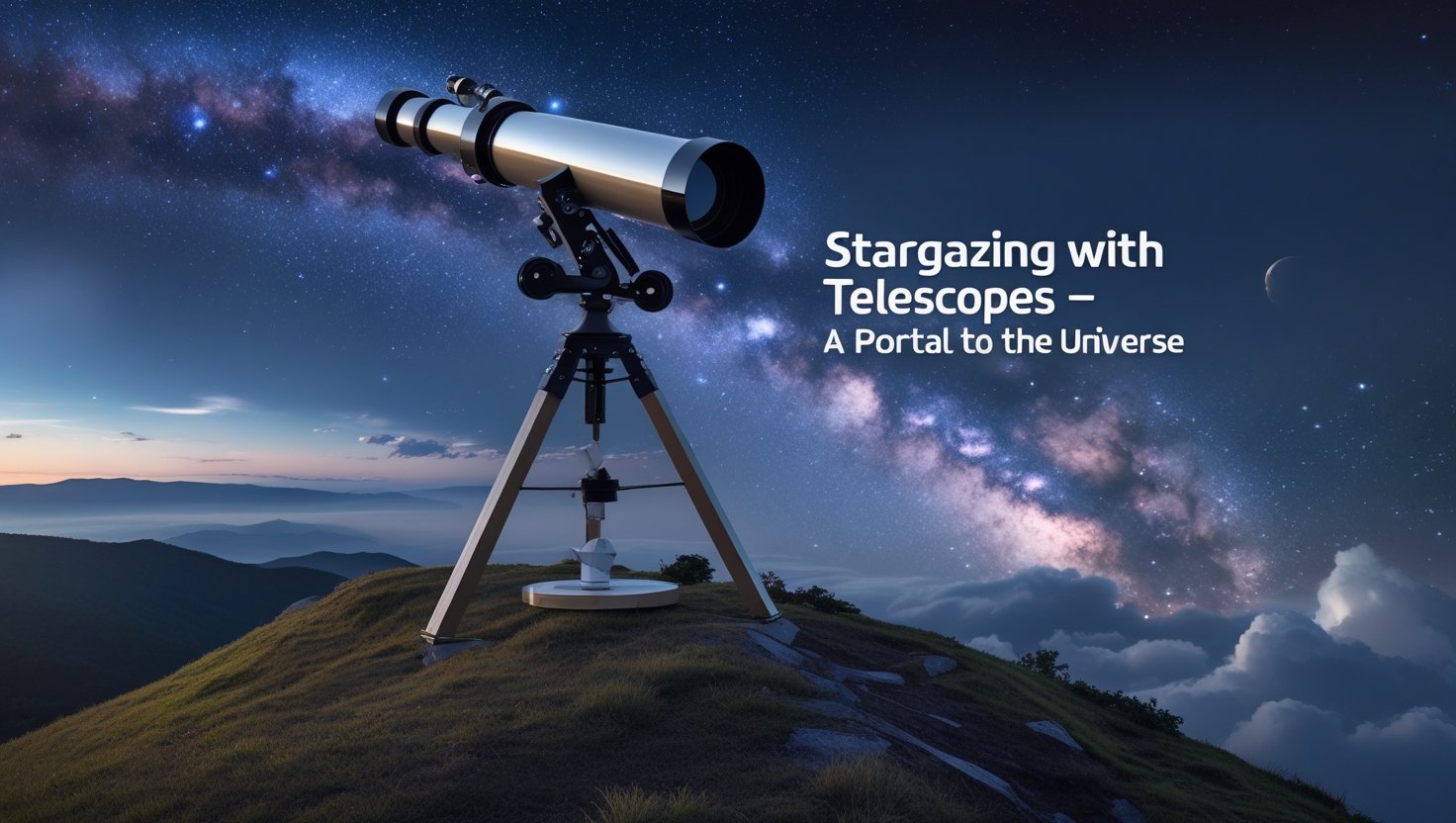
Stargazing With Telescopes | A Portal to the Universe
Picture this: one moment you’re standing in your backyard, and the next, you’re peering 13.8 billion years into the past, witnessing the birth of galaxies. Stargazing with telescopes isn’t just a hobby, it’s your personal time machine and portal to the universe, transforming ordinary nights into extraordinary cosmic adventures.
Why Telescopes Are Universe Gateways:
Stargazing with telescopes isn’t just about looking at distant objects, it’s about connecting with the fundamental forces that shaped our existence. Every photon of light that enters your telescope has traveled millions or billions of years to reach your eye, carrying stories of stellar births, galactic collisions, and cosmic phenomena that defy imagination.
When you point your telescope skyward, you’re not just observing space; you’re literally looking back in time. The portal to the universe opens not just spatially, but temporally, allowing you to witness the cosmic history that led to your very existence.
Understanding Your Cosmic Instrument:
The Light-Gathering Revolution
The magic of stargazing with telescopes begins with understanding how these instruments capture and focus light. Unlike your naked eye, which can only collect light through your pupil, telescopes gather light across their entire aperture, dramatically increasing the amount of cosmic information reaching your vision.
Telescopes work on a simple principle: the larger the light-gathering surface, the more distant and faint objects become visible. This is why stargazing with telescopes reveals celestial wonders completely invisible to the naked eye, transforming your perception of the night sky from a few thousand visible stars to billions of cosmic treasures.
Optical Configurations That Matter
Modern telescopes come in three primary optical designs, each offering unique advantages for different types of cosmic exploration:
- Refractor telescopes use lenses to bend light, providing crisp, high-contrast images perfect for planetary observation
- Reflector telescopes employ mirrors to gather light, offering excellent deep-sky performance at budget-friendly prices
- Compound telescopes combine mirrors and lenses, delivering versatility in a compact, portable package
Understanding these configurations helps you choose the perfect instrument for your stargazing with telescopes journey, ensuring maximum satisfaction with your cosmic adventures.
Navigating the Telescope Marketplace:
Budget-Conscious Universe Exploration
Stargazing with telescopes doesn’t require breaking the bank. Quality entry-level instruments can provide decades of cosmic discovery without emptying your savings account. The key is understanding which features matter most for your specific astronomical interests.
For planetary observation, prioritize instruments with high-quality optics and stable mounts. For deep-sky exploration, focus on aperture size and light-gathering power. Telescopes in the $200-500 range often provide exceptional value, offering performance that would have amazed professional astronomers just decades ago.
Advanced Features Worth Considering
Modern telescopes offer sophisticated features that enhance your stargazing with telescopes experience:
- GoTo mounts automatically locate and track celestial objects
- Smartphone integration provides real-time sky maps and object identification
- Motorized tracking compensates for Earth’s rotation, keeping objects centered
- Computerized databases contain thousands of pre-programmed cosmic destinations
Red Flags to Avoid
Not all telescopes are created equal. Avoid instruments that emphasize magnification over aperture, as these often disappoint beginners. Quality telescopes focus on light-gathering ability and optical precision rather than extreme magnification claims.
Beware of telescopes with flimsy mounts, plastic focusers, or suspiciously low prices from unknown manufacturers. Your stargazing with telescopes experience depends heavily on instrument stability and optical quality.
Mastering the Art of Cosmic Observation:
Setup Strategies for Success
Successful stargazing with telescopes begins long before you look through the eyepiece. Proper setup and preparation dramatically impact your observational experience and determine whether your evening becomes magical or frustrating.
Choose observing locations away from city lights, where light pollution won’t wash out faint cosmic objects. Even moderate light pollution can dramatically reduce the effectiveness of your telescopes, making deep-sky objects invisible and reducing the overall quality of your cosmic experience.
Timing Your Universal Adventures
Stargazing with telescopes rewards patience and planning. The best observing conditions occur during specific times and seasons when atmospheric conditions optimize telescope performance and celestial objects reach ideal positions.
New moon periods provide the darkest skies for deep-sky observation, while full moons offer excellent opportunities for lunar exploration. Understanding these cycles helps you plan stargazing with telescopes sessions that maximize your cosmic discoveries.
Weather Wisdom for Astronomers
Atmospheric conditions significantly impact telescope performance. Clear skies don’t always guarantee good seeing conditions – atmospheric turbulence can make stars appear to twinkle and dance, reducing image quality and making high-magnification observations difficult.
The best stargazing with telescopes conditions occur when high-pressure systems dominate, creating stable atmospheric conditions that allow telescopes to perform at their optical limits.
Celestial Targets That Will Transform Your Perspective:
Solar System Spectacles
Stargazing with telescopes reveals our solar system’s incredible diversity and beauty. The Moon becomes a detailed landscape of craters, mountains, and ancient impact basins. Jupiter displays its famous Great Red Spot and four largest moons dancing in orbital choreography.
Saturn’s rings appear as delicate cosmic jewelry, while Mars reveals seasonal changes and polar ice caps. Venus shows phases like the Moon, and Mercury challenges observers with its elusive appearance near the horizon.
Deep-Sky Wonders Beyond Imagination
Beyond our solar system, telescopes reveal cosmic phenomena that challenge human comprehension. The Andromeda Galaxy appears as a ghostly spiral containing over one trillion stars. The Orion Nebula glows with the light of stellar birth, while the Ring Nebula showcases a dying star’s final act.
Stargazing with telescopes unveils double stars with contrasting colors, globular clusters containing hundreds of thousands of ancient stars, and galaxies so distant their light began its journey when the universe was young.
Seasonal Sky Treasures
Each season brings unique opportunities for stargazing with telescopes. Spring offers galaxy season, when the Milky Way’s center drops below the horizon, revealing countless external galaxies. Summer provides nebula season, with stellar nurseries and cosmic clouds dominating the sky.
Autumn brings return of the Andromeda Galaxy to evening skies, while winter showcases the brilliant Orion region with its stellar diamonds and cosmic treasures.
Advanced Techniques for Cosmic Mastery:
Astrophotography: Capturing the Universe
Modern telescopes can be transformed into cosmic cameras, capturing images that surpass what the human eye can perceive. Even smartphones can photograph bright planets and the Moon through telescope eyepieces, while dedicated cameras reveal nebulae, galaxies, and star clusters in stunning detail.
Stargazing with telescopes evolves into cosmic artistry when you begin capturing and processing images. Digital techniques reveal colors and details invisible to visual observation, creating personal cosmic galleries that document your astronomical journey.
Observation Logging and Progress Tracking
Serious stargazing with telescopes enthusiasts maintain detailed observation logs, recording seeing conditions, equipment used, and personal impressions of each cosmic target. These logs become valuable references for future observations and help track your developing skills.
Digital logging apps and online databases make it easy to maintain comprehensive records of your telescope observations, connecting you with a global community of amateur astronomers sharing similar cosmic passions.
Upgrading Your Cosmic Arsenal
Stargazing with telescopes often leads to equipment upgrades as your skills and interests develop. High-quality eyepieces, specialized filters, and precision mounts can dramatically enhance your observational capabilities without requiring entirely new telescopes.
Understanding which upgrades provide the most significant improvements helps you invest wisely in your stargazing with telescopes future, ensuring continued growth in your cosmic exploration capabilities.
The Science Behind Stellar Observation:
Light Pollution’s Impact on Universe Access
Modern civilization’s artificial lighting creates a veil that obscures the cosmic portal to the universe. Light pollution doesn’t just hide faint stars – it fundamentally alters our relationship with the cosmos, disconnecting us from the star-filled skies that inspired human civilization.
Stargazing with telescopes becomes an act of cosmic rebellion against light pollution, using optical instruments to pierce through the artificial glow and reconnect with the universe that surrounds us.
Atmospheric Physics and Telescope Performance
Earth’s atmosphere acts as a dynamic lens between your telescope and cosmic targets. Understanding atmospheric effects helps you optimize observing sessions and explains why stargazing with telescopes sometimes produces variable results.
Atmospheric turbulence creates the twinkling effect that makes stars appear to dance, while thermal currents can distort telescope images. The best telescope observers learn to work with atmospheric conditions rather than fighting against them.
The Physics of Cosmic Light
Every photon entering your telescope carries information about its cosmic origin. Starlight reveals stellar temperatures, compositions, and distances, while galaxy light tells stories of cosmic evolution and universal expansion.
Stargazing with telescopes transforms you into a cosmic detective, using light as evidence to understand the universe’s structure, history, and future evolution.
Building Your Astronomical Community:
Joining the Global Stargazing Family
Stargazing with telescopes connects you with a worldwide community of cosmic enthusiasts. Local astronomy clubs offer shared knowledge, equipment access, and group observing sessions that enhance your astronomical journey.
Online forums and social media groups provide platforms for sharing observations, asking questions, and connecting with experienced telescope users who can guide your cosmic exploration.
Sharing Your Cosmic Discoveries
Modern stargazing with telescopes includes opportunities to contribute to citizen science projects. Variable star observations, asteroid tracking, and exoplanet detection programs allow amateur astronomers to contribute meaningful data to professional research.
Your telescope observations can literally advance human knowledge of the universe, transforming personal cosmic exploration into contributions to our species’ understanding of existence itself.
Inspiring the Next Generation
Stargazing with telescopes naturally leads to sharing cosmic wonder with others. Whether introducing family members to Saturn’s rings or guiding neighborhood children through their first lunar observations, telescopes become tools for spreading cosmic awareness.
The sense of wonder that comes from seeing Jupiter’s moons or the Andromeda Galaxy for the first time creates lasting memories and often ignites lifelong passions for cosmic exploration.
The Future of Amateur Astronomy:
Technological Revolutions in Telescope Design
Modern telescopes incorporate technologies that were science fiction just decades ago. Automated tracking systems, computerized databases, and smartphone integration make stargazing with telescopes more accessible than ever before.
Future developments promise even more dramatic improvements, with adaptive optics, artificial intelligence assistance, and remote observing capabilities transforming how we explore the portal to the universe.
Citizen Science and Cosmic Contribution
Stargazing with telescopes increasingly involves contributions to professional astronomy research. Citizen science projects harness the collective power of amateur astronomers to monitor variable stars, track asteroids, and search for exoplanets.
Your telescope observations can contribute to discoveries that expand human knowledge of the cosmos, making every observing session a potential contribution to our species’ cosmic understanding.
The Democratization of Universe Access
Affordable telescopes and digital imaging technologies are democratizing access to cosmic exploration. High-quality astronomical equipment that once required institutional budgets is now available to individual enthusiasts.
This democratization means that stargazing with telescopes will continue expanding, bringing cosmic awareness to ever-larger portions of humanity and fostering a deeper connection with our universal home.
Conclusion:
Stargazing with telescopes opens a portal to the universe that transforms your relationship with existence itself. Through these remarkable instruments, you join a cosmic conversation that spans billions of years, connecting with the fundamental forces that created everything you see, touch, and experience. Your journey into the cosmos begins with a single look through a telescope eyepiece, but it extends infinitely into the depths of space and time.
FAQs:
Q1: What’s the best telescope for beginners interested in stargazing?
A: A 6-8 inch reflector or 4-inch refractor on a stable mount provides excellent beginner performance.
Q2: How much should I spend on my first telescope?
A: Quality beginner telescopes range from $200-500, offering years of cosmic exploration value.
Q3: Can I see galaxies and nebulae with a small telescope?
A: Yes, many deep-sky objects are visible with modest telescopes under dark skies.
Q4: Is stargazing with telescopes possible from the city?
A: Bright objects like planets and the Moon remain visible, but dark skies reveal much more.
Q5: How difficult is it to learn telescope operation?
A: Basic operation is straightforward, but mastering cosmic navigation takes practice and patience.
Q6: Can I photograph celestial objects with my telescope?
A: Yes, even smartphones can capture lunar and planetary images through telescope eyepieces successfully.