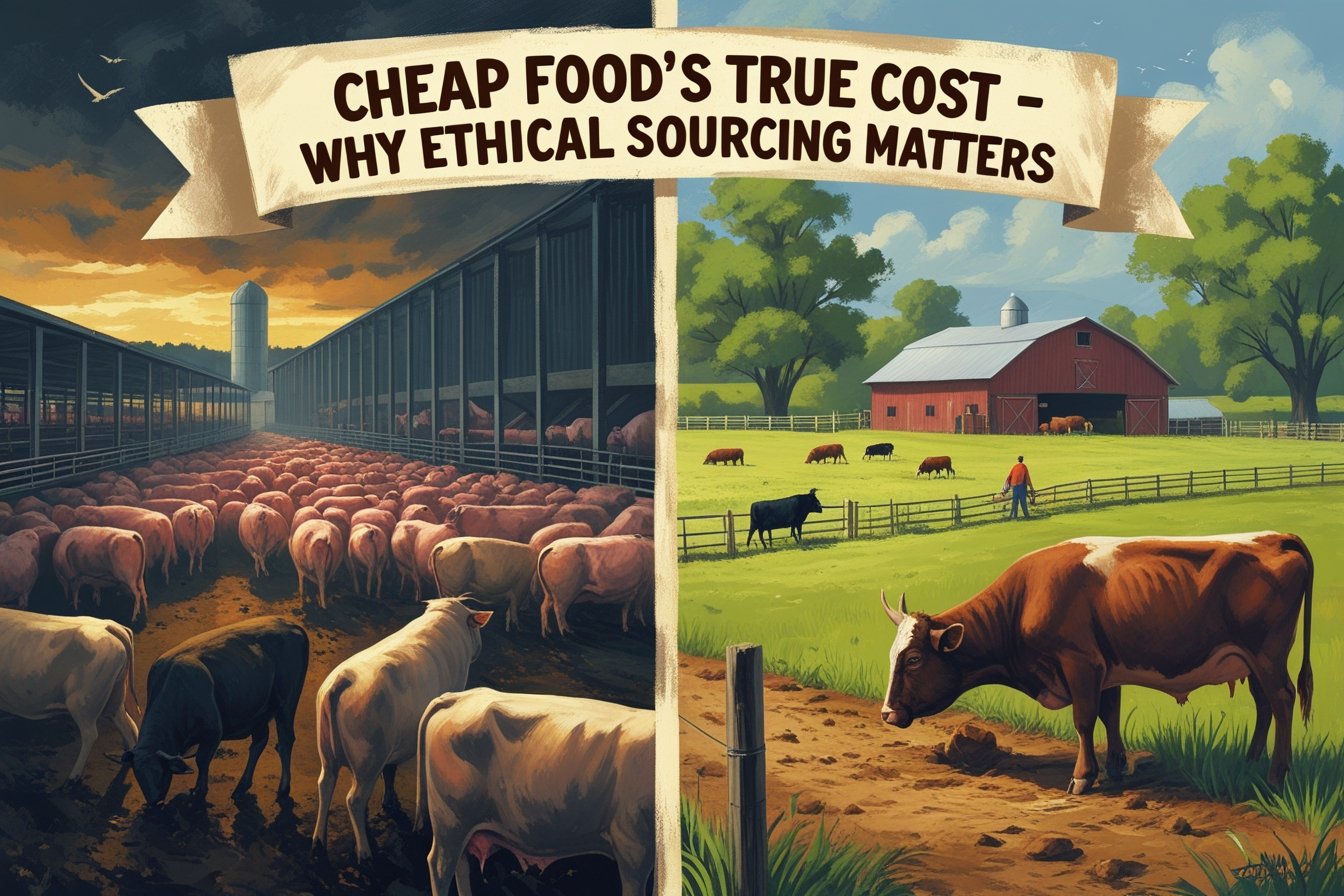
Cheap Food’s True Cost | Why Ethical Sourcing Matters
That $3 hamburger isn’t really $3, it’s costing society roughly double the apparent cost when you factor in hidden environmental costs, health impacts, and social consequences. Every dollar saved at checkout creates invisible debts paid by communities, ecosystems, and future generations through cheap food production.
The Mathematics of Deception:
Cheap food economics operate on a simple principle: transfer costs to someone else’s balance sheet. When agricultural corporations slash prices, they’re not absorbing losses, they’re shifting expenses to taxpayers, healthcare systems, and environmental cleanup efforts. This cost displacement creates an illusion of affordability while generating massive hidden food costs that society pays through different channels.
The true cost accounting reveals staggering numbers. Around 70 percent ($8.1 trillion) arises from unhealthy dietary patterns and is linked to alarming non-communicable diseases like heart disease, stroke, and diabetes. These figures don’t include environmental restoration, water treatment, or social support systems required to address the consequences of industrial food production.
Modern consumers unknowingly participate in this shell game every time they choose products based solely on sticker price. The cost externalization strategy allows companies to compete on price while communities bear the burden of environmental degradation, worker exploitation, and public health crises generated by unsustainable food systems.
Environmental Debt:
Industrial agriculture generates environmental costs that dwarf the savings consumers see at checkout. Soil depletion, water contamination, biodiversity loss, and greenhouse gas emissions represent massive debts that future generations will inherit. These environmental externalities don’t appear on corporate balance sheets, but they accumulate interest in the form of climate change, ecosystem collapse, and resource scarcity.
Monoculture farming practices that enable cheap food production strip the soil of nutrients, requiring increasingly expensive inputs of synthetic fertilizers and pesticides. The long-term cost of rehabilitating degraded farmland far exceeds the short-term savings from intensive agricultural methods. Meanwhile, chemical runoff creates dead zones in waterways, requiring billion-dollar cleanup efforts funded by taxpayers rather than the companies generating the pollution.
Carbon footprint calculations for cheap food rarely include the full lifecycle costs of production, transportation, and disposal. When these factors are properly accounted for, many seemingly affordable products become environmental luxuries that society cannot afford at current consumption levels.
The Human Cost of Low Prices:
Cheap food pricing relies heavily on exploitative labor practices that keep wages artificially low while working conditions remain dangerous and degrading. Migrant farm workers, processing plant employees, and restaurant staff often work for sub-living wages without benefits, forcing them to rely on public assistance programs that effectively subsidize corporate profits.
The labor cost externalization strategy allows food companies to compete on price while taxpayers fund food stamps, healthcare, and housing assistance for underpaid workers. This creates a perverse economic cycle where consumers pay twice, once at checkout and again through tax-funded social programs supporting workers who cannot afford basic necessities on their wages.
Worker safety violations in industrial food production generate additional hidden costs through workplace injury claims, healthcare expenses, and regulatory enforcement. The savings from cutting safety measures get passed to consumers as lower prices, while society absorbs the costs of treating injured workers and enforcing labor protections.
Health Consequences:
Processed food consumption drives a healthcare crisis that costs society trillions annually in medical treatments, lost productivity, and reduced quality of life. The cheap food industry optimizes products for shelf stability, extended storage, and low production costs rather than nutritional value, creating foods that contribute to obesity, diabetes, heart disease, and other chronic conditions.
Food additives, preservatives, and processing techniques that enable cheap food production often compromise nutritional content while introducing potentially harmful compounds. The long-term health effects of these ingredients generate medical costs that far exceed the savings consumers realize through lower food prices.
Nutritional deficiency resulting from cheap food diets creates cascading health problems that require expensive medical interventions. Communities with limited access to fresh, nutritious foods experience higher rates of preventable diseases, generating healthcare costs that get distributed across insurance systems and public health programs.
Supply Chain Transparency:
Food supply chain opacity allows companies to conceal unethical sourcing practices while marketing products as affordable and convenient. Complex distribution networks, subcontracting arrangements, and international suppliers make it difficult for consumers to understand the true origins and production methods behind their food purchases.
Traceability systems in ethical food sourcing reveal the hidden costs of cheap food production by documenting environmental damage, labor violations, and quality compromises throughout the supply chain. Companies that invest in transparency often discover that their cheap suppliers achieve low prices through practices that generate significant external costs.
Audit failures and inadequate oversight in global food systems allow problematic practices to persist while consumers remain unaware of the true costs associated with their purchases. The savings from avoiding proper supply chain management get passed to consumers while society deals with the consequences of unethical sourcing.
How Cheap Food Destroys Communities:
Industrial agriculture concentrates production in large-scale operations that displace local farmers, destroy rural economies, and eliminate food security for entire regions. The cheap food economy undermines local food systems by making it impossible for small-scale producers to compete on price while maintaining sustainable farming practices.
Rural community collapse resulting from industrial agriculture generates social costs, including unemployment, population decline, infrastructure abandonment, and loss of agricultural knowledge. These communities often become dependent on external food sources, increasing vulnerability to supply chain disruptions while losing the capacity for local food production.
Food desert creation occurs when cheap food retailers drive local grocery stores out of business, then close their own operations when profit margins decline. This leaves communities without access to fresh, nutritious foods while forcing residents to travel longer distances or rely on processed alternatives.
Consumer Psychology:
Price sensitivity in food purchasing decisions often overrides concerns about ethical sourcing, environmental impact, and long-term consequences. This consumer behavior reflects both economic necessity and psychological biases that favor immediate savings over future costs. Understanding these patterns helps explain why cheap food maintains market dominance despite its hidden costs.
Marketing strategies for cheap food products exploit cognitive biases by emphasizing upfront savings while minimizing discussions of quality, sustainability, or ethical production methods. Promotional pricing, bulk discounts, and convenience positioning make cheap food appear more attractive than alternatives that internalize their true costs.
Information asymmetry between producers and consumers allows cheap food companies to maintain pricing advantages by concealing the full costs of production. Most consumers lack the time, resources, or expertise to research supply chain practices, creating market conditions that reward companies for externalizing costs rather than improving practices.
The Economics of Ethical Alternatives:
Ethical food sourcing often appears more expensive because it internalizes costs that cheap food production externalizes to society. When companies pay living wages, implement sustainable farming practices, and maintain transparent supply chains, these investments appear in product pricing rather than being shifted to taxpayers and future generations.
Fair trade certification, organic production, and local sourcing represent attempts to create pricing systems that reflect true production costs. While these products often carry higher sticker prices, they reduce the hidden costs that society pays through environmental cleanup, healthcare expenses, and social support programs.
Market transformation toward ethical sourcing requires consumer education about the total cost of ownership for food products. When hidden costs are properly accounted for, many ethically sourced products become more economical than their cheap alternatives over longer time horizons.
Corporate Accountability:
Regulatory frameworks for food production often fail to capture the full costs of industrial agriculture, allowing companies to externalize expenses while competing on price. Effective policy interventions would require companies to internalize environmental, social, and health costs through taxes, fees, or mandatory insurance programs.
Extended producer responsibility models could force food companies to pay for the entire lifecycle costs of their products, including environmental cleanup, health impacts, and social consequences. This approach would eliminate the artificial price advantages that cheap food currently enjoys through cost externalization.
Consumer pressure for corporate transparency can drive changes in sourcing practices by making hidden costs visible to stakeholders. Companies that face scrutiny over their supply chain practices often discover that investing in ethical sourcing improves both their public image and long-term financial performance.
Building Sustainable Food Systems:
Local food networks offer alternatives to cheap food systems by creating direct relationships between producers and consumers. These systems often achieve better cost efficiency by eliminating intermediaries, reducing transportation costs, and building community resilience against supply chain disruptions.
Regenerative agriculture practices can restore damaged ecosystems while producing food that competes economically with industrial agriculture over longer time periods. Initial investments in sustainable farming methods often pay dividends through improved soil health, reduced input costs, and premium pricing for ethically produced products.
Policy interventions that properly price environmental and social costs would level the playing field between cheap food and ethical alternatives. Carbon taxes, water usage fees, and labor protection enforcement could eliminate the artificial advantages that cheap food production currently enjoys through cost externalization.
Consumer Strategies:
Informed purchasing decisions require understanding the total cost of ownership for food products, including hidden environmental, health, and social costs. Consumers who factor these considerations into their purchasing decisions often find that ethically sourced products provide better value despite higher upfront costs.
Seasonal eating and local sourcing can reduce both financial and environmental costs by aligning consumption patterns with natural production cycles. These approaches often provide fresher, more nutritious foods at competitive prices while supporting sustainable agriculture practices.
Meal planning and home cooking strategies can make ethical food choices more affordable by reducing reliance on processed foods and restaurant meals. These practices allow consumers to invest in higher-quality ingredients while maintaining reasonable food budgets.
Technology Solutions:
Blockchain technology and supply chain tracking systems are making it easier for consumers to understand the true costs and origins of their food purchases. These tools provide transparency that allows market forces to reward ethical sourcing while penalizing companies that externalize costs.
Mobile applications for ethical shopping help consumers identify products that align with their values while providing information about supply chain practices, environmental impact, and social responsibility measures. These tools make ethical sourcing more accessible to mainstream consumers.
Data analytics platforms can help consumers understand the total cost of ownership for different food choices by aggregating information about health impacts, environmental costs, and social consequences. This information empowers better decision-making while creating market incentives for ethical food production.
Conclusion:
The true cost of cheap food extends far beyond checkout prices, creating massive debts paid by society through healthcare systems, environmental cleanup, and social support programs. Ethical sourcing offers a path toward sustainable food systems that internalize costs rather than shifting them to future generations.
FAQs:
Q1: How much more expensive is ethically sourced food compared to cheap alternatives?
A: Ethical food typically costs 20-50% more upfront but saves money long-term through reduced healthcare and environmental costs.
Q2: Can I afford to buy ethically sourced food on a tight budget?
A: Start with local seasonal produce and bulk purchases of organic staples to make ethical sourcing more affordable.
Q3: How do I verify that food is actually ethically sourced?
A: Look for third-party certifications like Fair Trade, USDA Organic, or B-Corp that require independent verification.
Q4: What’s the biggest hidden cost of cheap food production?
A: Healthcare expenses from diet-related diseases account for over 70% of hidden food costs globally.
Q5: Do ethical sourcing practices really make a difference environmentally?
A: Sustainable farming methods can sequester carbon, restore biodiversity, and reduce water pollution significantly.
Q6: How can I support ethical food systems without breaking my budget?
A: Focus on reducing food waste, cooking at home more, and gradually transitioning to ethical alternatives for staple items.